Represent & Animate

tumblr_lj0wls8poh1qb9bjho1_400

muybridge5

muybridge horse

Muybridge-child-plate-475

child-frames

Photoshop layers view

Edweard Muybridge

In this project you will work with poetry­—interpreting, mashing up, composing a text—then translating to create animated narratives using found or generated photographic and graphic images. You’ll first develop texts and a static image (storyboard) as a design plan, then produce an animated interpretation (not an illustration) that expresses the spirit and meaning of the text.

Like contemporary postmodern digital culture, Dada poetry and photomontage are relevant starting points for this project as they originate in media and, when mashed-up, can be simultaneously nonsensical, random and curiously poignant. Dada was an art movement formed during the First World War as a reaction to the horrors and folly of the war. The art, poetry and performances produced by Dada artists are often satirical and nonsensical in nature, making the absurd into a critique of modern culture.

Photomontage, the making of composite photographs by cutting, gluing, rearranging and overlapping photographs into a new image, was one of the techniques used by Dada artists to criticize corrupt culture.

For Project 2 you can use any text as a source to interpret or compose. See these sources: the Poetry Foundation, and Poets.org.

The project has 2 parts: a static image/storyboard and a 25-30 second movie file with sound (for screening Tuesday October 29).

* Readings/Video/Sites, for October 15: (discussion leaders:     )

* Video, Animated Gifs – the Birth of a New Medium

* Reading from McCloud’s Understanding Comics, The Six Steps

* Visual Remix

Postmodernism, definition (read Hebdige’s quote, p 154-155)

Dada Was Born 100 Years Ago, So What?, NYTimes

* How to Make a Dadaist Poem, Tristan Tzara, 1920

Dada Poetry Generator

For browsing:

Julian Rosefeldt Manifesto video installation – # 6 is the Dada manifesto

Gifs Worth at Least a Thousand Words, NYTimes


hoch

The Art Critic 1919-20 by Raoul Hausmann 1886-1971

Fall 2017 animations

Spring 2018 animations

Selected student animations, fall 2015 , fall 2016, and summer 2016

First Gif sketches, and more

“Meet and Mingle” – Dorothy Espalto
espalto.project2.2.animation

Final version (with sound)

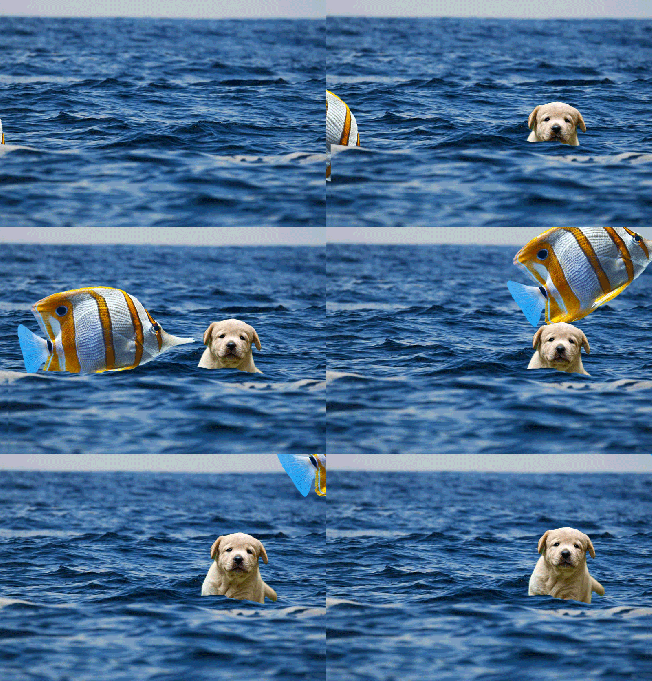
sleepingpuppy

Animation exercise spring 2018
Animation exercise summer 2018
Animation exercise 2017
Animation exercise 2016
Summer 2016
GIF animations 2015

Relevant Artists:
2181c87b0622b9960a9fbb023085782c

Language of Vision

moholy 1

“Visual communication is universal and international; it knows no limits of tongue, vocabulary, or grammar, and it can be perceived by the illiterate as well as by the literate…[The visual arts, as] the optimum forms of the language of vision, are, therefore, an invaluable educational medium,”  György Kepes, Language of Vision, 1944

“To design is to devise courses of action aimed at changing existing situations into preferred,”  Herbert Simon, economist and political scientist

“I think of my abstract mark-making as a type of sign lexicon, signifier, or language for characters that hold identity and have social agency.”  Julie Mehretu, artist

“Pictures of nothing.”  Kirk Varnedoe, art historian

Language of Vision

Revised Schedule Projects 1.3 and 2

Here’s a revised schedule for the crit of Project 1.3 and the start of Project 2:

Project 1.3
Abstract interpretation of an Invisible City from Calvino
Assigned 9.24, Due 10.15

Project 2 will start on October 3 with an introduction to Photoshop animation. On October 8 we’ll have a visit by artist/designer Christina Kerns and a GIF animation exercise.
shark
Fall break, October 10. No class.
Sunday, October 20, Photoshop animation tutorial.

sleepingpuppy
12 frame Gif animation.
2015, 2016, 2016s,  2017, 2018, 2018s


Grading Art and Design

leo-cullum-critics-in-love-new-yorker-cartoon

“I am interested in what is interesting,” Ed Ruscha, artist

How do you evaluate—grade?— art and design work?

The criteria and issues that stand out for me are:

1. skill to describe/articulate and frame a design question or problem verbally, visually or via some other form

2. participation in the studio and contribution to the studio culture

3. ability to transform ideas and rough concepts; to develop, refine, and successfully express or communicate

4. curiosity and willingness to experiment/explore/discover and to distill knowledge from this process

5. mastery of materials and craft in completing project (to the level required)

6. synthesis and aesthetics – create forms and relationships – to put things together with a level of completeness and in an engaging manner appropriate to the project

7.  production of a body of work that demonstrates your design process and  expresses what is interesting about the work by embedding meaning (your point of view, argument, interests, questions) in the work itself

Invisible Cities

“The eye does not see things but images of things that mean other things.”
(from p.13, in Cities and Desire)

That line nicely summarizes a way of thinking about project 1.3. For this project select one story from Calvino’s Invisible Cities and visually represent (without illustrating) the signs and symbolic meanings expressed in the text. As in the previous work, the final should include 6 studies on a tabloid page and a final design printed 12×12” — full color. Project specifications and examples are on the blog.

You might consider this exercise as a project to produce a painting or book jacket image. Here are a few interpretations:

calvino cover7calvino cover1calvino cover2invisible_cities_book_cover_designcalvino cover3calvino cover4calvino cover5calvino cover6