Paul Klee

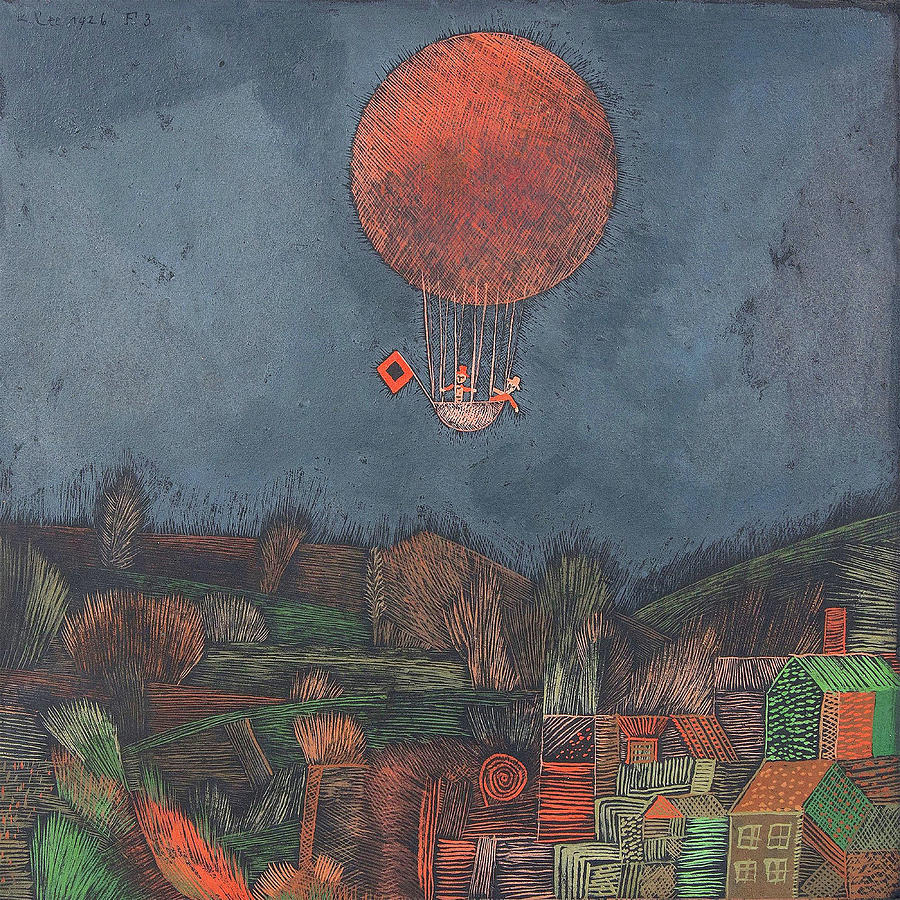
Actor’s Mask by Paul Klee (1924)

Paul Klee (1879-1940) was a German artist whose works exhibited traits of surrealism, cubism, and expressionism. Throughout his life, Klee made multiple publications regarding the study of color and form (Writings on Form and Design Theory/Paul Klee Notebooks), and taught at Bauhaus School of Art, Design, and Architecture.

In Klee’s younger years, his parents encouraged him to pursue music professionally, but the option did not appeal to him, as he was not able to find a meaningful outlet for creative self-expression and introducing radical ideas, as he felt “modern music lacked meaning” for him. By the time Klee was a young adult, he was already skilled in drafting and had a knack for drawing caricatures. His parents reluctantly allowed him to start studying at the Academy of Fine Arts in Munich. He excelled in drawing, but recounted experiencing struggle in color-sense, and felt that perhaps he would never successfully learn how to paint.

After graduation, Klee gained a few trustworthy and loyal collectors of his work, and began to study other artists based on their use of color. Klee, upon seeing Vincent Van Gogh’s work, said, “Permit me to be scared stiff.” He would later say that Van Gogh allowed him to see color as an expression of emotion.

A visit to Tunisia in 1914 changed Klee’s art direction and compelled him to begin experimenting with color as a separate entity from the subject of which they are part of. He noted that he was impressed by the quality of light there, and remaining faithful to a model was no longer important.

Colour has taken possession of me; no longer do I have to chase after it, I know that it has hold of me forever. Colour and I are one. I am a painter.

– Paul Klee
The Bavarian don Giovanni, Paul Klee (1919)

His later works became increasingly somber, a reflection of the political turmoil in Europe throughout the two World Wars. One of his last paintings, Death and Fire, was created when Klee was struggling with several painful illnesses.

Ad Parnassum, Paul Klee (1932)
Death and Fire, Paul Klee (1940)

I cannot be grasped in the here and now, For my dwelling place is as much among the dead, As the yet unborn, Slightly closer to the heart of creation than usual, But still not close enough.

– Paul Klee’s Epitaph
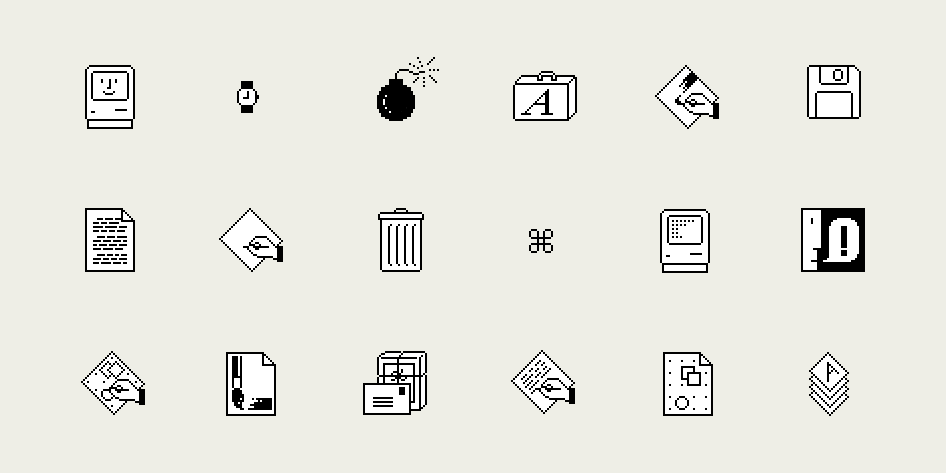
Susan Kare – UI and Typeface for Macintosh

Susan Kare is an artist/graphic designer who created many of the icons that are universally recognized today in every photo editing or drawing software (paint bucket, lasso, and the grabber to name a few). These images are key in the communication between the user and the computer, and the design process requires minimizing and simplifying information.

Before getting her job at Apple, Kare had experience in various forms of “pseudo digital art” like mosaics or needlepoint, which could roughly be translated to bitmap. Some of the inspiration behind her iconography such as the “command” key on a Mac was taken from the Swedish symbol meaning “something interesting.” An old “Copy File” icon underwent numerous changes from the symbol of a copier to the image of a cat in a mirror representing “copy cat.” Additional challenges were present in abstract ideas like “undo.”

She worked for Macintosh extensively as well as Microsoft, IBM, and Facebook.

When symbols are meaningful and well crafted, they need not be frequently redesigned.

Susan Kare

She is currently using Photoshop and Illustrator for her designs.

Julie Mehretu

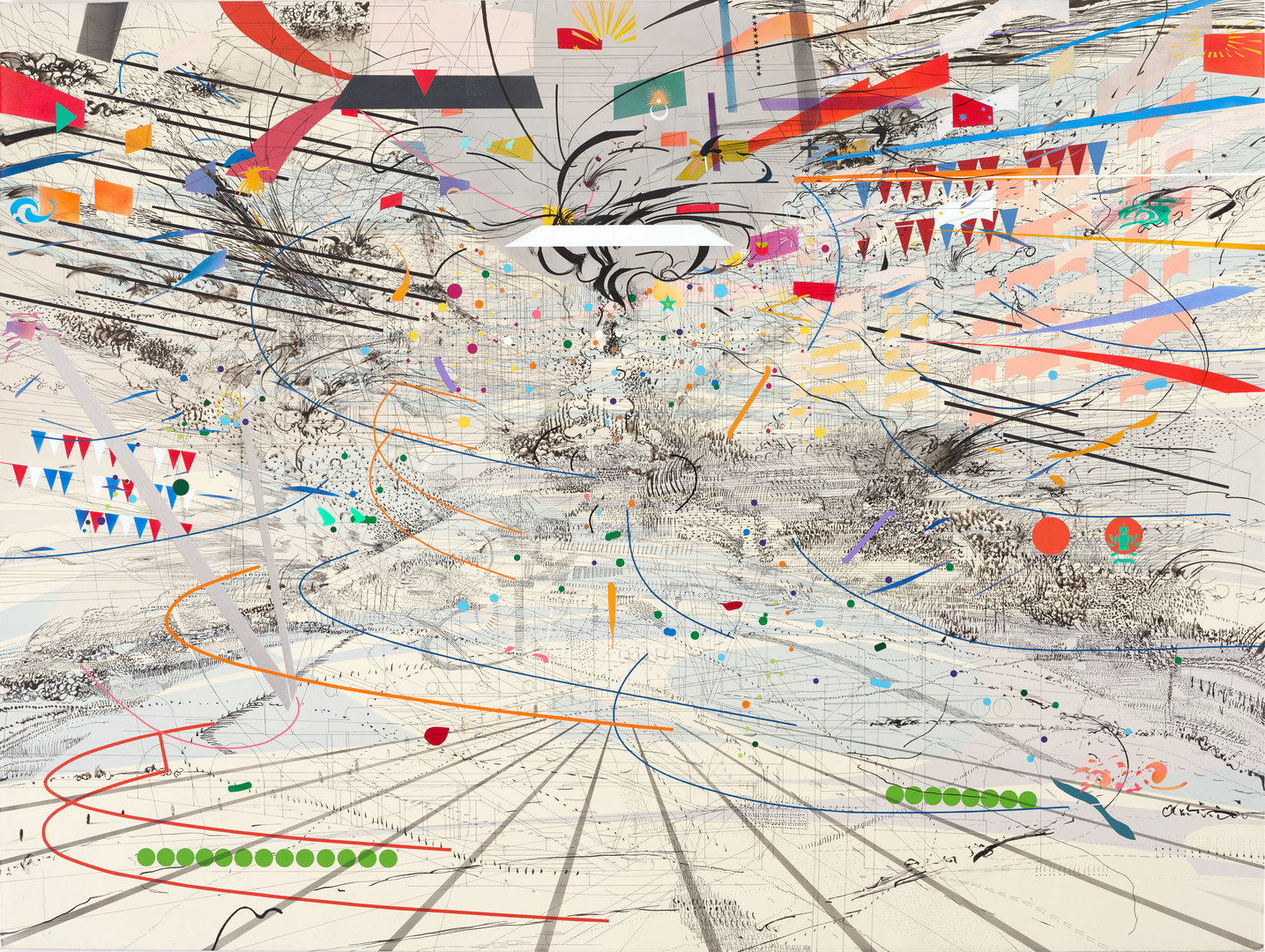
Julie Mehretu’s art was intriguing to me because we briefly learned about her last semester in FNAR123, additionally, her art reminds me of the pieces I see in DRL. I find the collaboration between math and art to be very satisfying and aesthetically pleasing, because they often look as though they were generated by machines as the byproduct of calculations. They look like pieces put together from the scraps and remains of analogue computers’ punch cards.

Julie Mehretu’s “Congress”
DRL artwork

I noticed that in both pieces above, there are elements brought to the front and more muted shapes that resemble guidelines in the back. Defined shapes such as circles, triangles, and lines make up the majority of both pieces, though Mehretu’s piece contains more varied textures/strokes.

Mehretu was born to an Ethiopian and American household. Her family left Ethiopia in 1977 to escape political turmoil, and as such, many of Mehretu’s pieces express global changes in society and politics over a long period of time. 

The characters in my maps plotted, journeyed, evolved, and built civilizations. I charted, analyzed, and mapped their experience and development: their cities, their suburbs, their conflicts, and their wars. […] As I continued to work I needed a context for the marks, the characters. By combining many types of architectural plans and drawings I tried to create a metaphoric, tectonic view of structural history.

Julie Mehretu