Fearless Girl

The Charging Bull in Manhattan was by itself an illegal, unexpected art installment that quickly gained traction. But on March 7th, 2017, another statue was suddenly, but legally, placed in front of Charging Bull – a young, “fearless girl”, in anticipation of International Women’s Day. Sculpted by Kristen Visbal, it immediately provoked reactions from various media figures and the general populace. It was a hit among tourists, with tourists gathering to see it, and political pundits applauded its symbolic importance. The sculptor of Charging Bull, Arturo Di Modica, complained to city officials that it twisted the positive intent of his sculpture. Some also voiced concerns surrounding the origins of the sculpture, since it was commissioned by an investment management firm, State Street Global Advisors, to promote a new “gender-diverse” index fund.

Regardless, I thought that it was very interesting to see how an installment of a sculpture next to another one could alter its meaning. I saw this article from the DP which describes a similar scenario here at Penn: https://www.thedp.com/article/2018/12/ben-franklin-statue-art-installation-upenn-socioeconomic
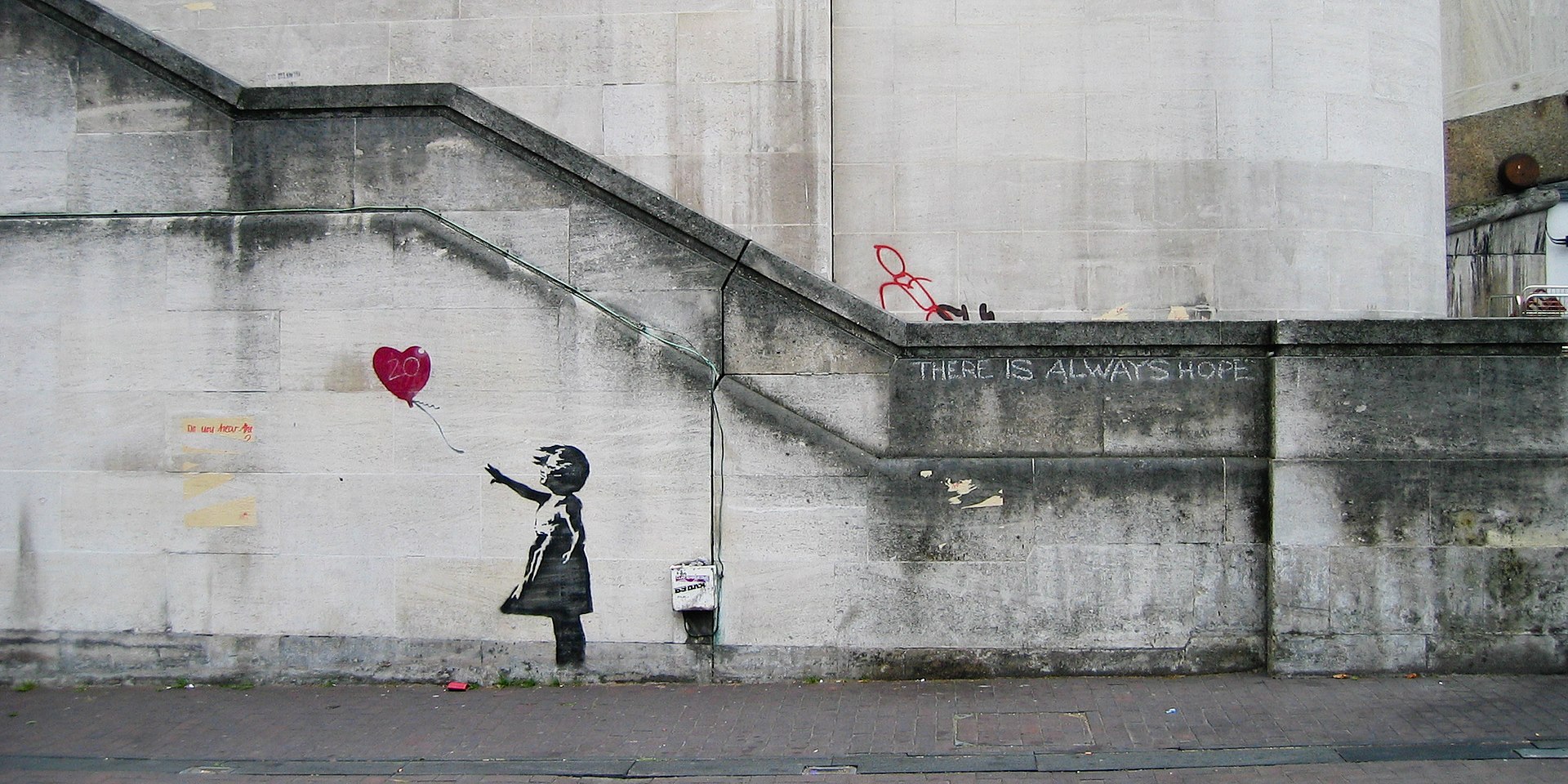

Banksy

Banksy Girl and Heart Balloon (2840632113).jpg

Banksy is an anonymous graffiti artist based in England whose stenciled, primarily black-and-white works of social commentary have gained worldwide renown. At the same time, many critics argue that any commentary in the graffiti artworks are usually a very obvious truth in the world, and that they are only superficially deep.

I felt that Banksy was perhaps one of the most well-known artists today that thrive off of an illegal act. His vandalism of public places to attract attention is closely related with Project 4, so I thought it was worth sharing.

Charging Bull

On December 14, 1989, sculptor Arturo Di Modica illegally placed a massive, 7100 pound bronze sculpture of a bull poised to charge in the Financial District of Manhattan. The NYPD would impound it shortly later that day, but a wave of public outcry persuaded officials to bring the bull back.

Di Modica intended the bull to inspire, as he considered it a gift to America for helping to fulfill his dream of becoming a sculpture. However, it has taken on other connotations as well, as some movements paint it as a kind of emblem of corporate greed. For example, the Occupy Wall Street movement created posters depicting the bull as an antagonistic force. Regardless, it has become a huge tourist attraction in the Financial District.

Image result for charging bull
The Charging Bull

Mattress Performance

In September 2014, visual arts student Emma Sulkowicz, then a senior at Columbia University, picked up a dorm mattress, and moved it with them as they went about their daily life. They would ultimately carry it until their graduation ceremony in May 2015. An endurance art project, they hoped to bring attention to an alleged rape that had occurred to them 3 years prior. The media quickly picked up on the project, and was the target of intense scrutiny. Many art critics praised it for its boldness and conspicuous nature, and various political pundits similarly applauded it for its critique of rape culture. It was also sharply criticized, as a number of columnists felt that it was unfair to their alleged rapist, calling it “shaming without proof”. Some commentators also questioned its validity as art. Regardless, I was reminded of this endurance art piece when looking over Project 4, since it similarly takes place on a campus to bring attention to something.

photograph
The mattress at the graduation ceremony.

Nathalie Miebach

Nathalie Miebach is a Boston-based artist dedicated to bringing physical form to abstract data. Using rope, paper, wood, reed, miscellaneous fibers, and various other arts and crafts tools, Miebach transforms seemingly mundane data regarding cycles of biology, currents, temperature variations, tidal patterns, and the like to create huge sculptures. Some sculptures even represent the “music” of storms around the world, and others can, in a sense, be carried/worn, as seen in the gallery above. Her works do not completely erase the data; on the contrary, they often have a significant resemblance with the data itself, and each piece is labeled to signify what they represent, as can also be seen above.

Dr. Strangelove or: How I Learned to Stop Worrying and Love the Bomb

Frequently rated by critics as one of the greatest films ever created, Stanley Kubrick’s 1964 film Dr. Strangelove satirizes the fears of nuclear conflict between the United States and the Soviet Union. The movie follows the disastrous attempts by the President and his advisors to recall a squadron of bombers sent to drop nuclear weapons on the Soviet Union. Although initially based after the book Red Alert, Kubrick transformed the screenplay from a morose examination of nuclear apocalypse to a black comedy.

(Spoilers) The movie satirizes a multitude of ideas, chief among them being mutually assured destruction, fallout shelters, and doomsday devices. A number of iconic moments from the film have been parodied across various media. Perhaps the most famous scene is when the nuclear bomb is dropped with the bomber pilot still on it: https://www.youtube.com/watch?v=snTaSJk0n_Y . (Also, a Simpson’s parody of it: https://youtu.be/Eu-i_9c3PJE?t=33)

Also, mentioned in class, the war room scene: https://www.youtube.com/watch?v=UAeqVGP-GPM

John Karel

John Karel is a Philadelphia-based animator with a penchant for low-poly, short GIFs. In 2014, he created a quirky neon skeleton that quickly became the star of many of his GIFs. He previously used Autodesk Maya before switching to Blender for his 3D animations.

Ghosts Before Breakfast

https://www.youtube.com/watch?v=rTwL54u7cSw (a link to Ghosts Before Breakfast)

Although most of the Dadaist works shown in class are still images or possibly GIFs, the Dada movement encompassed a vast range of media, from sound media to movies. One such film was Ghosts Before Breakfast, released in 1928 in Germany. Directed by avant-gardist Hans Richter, the sound is minimalist and disorienting, and the storyline and visuals are seemingly incoherent. Nonetheless, I found it very curious and even unsettling. Although not an extraordinarily well known film, it seemed highly relevant to our work in class.

Paul Robertson

Pixels GIF by Paul Robertson
Adult Swim Pixels GIF by Paul Robertson

Paul Robertson is an Australian animator that frequently deals with pixel art GIF animations, as can be seen above. His work has been featured in music videos, video games, movies, and TV shows (e.g., The Simpsons, Rick and Morty, Scott Pilgrim vs. the World). Personally, I find his use of vibrant, disco-like color and fast pace to be a very effective way of conveying a sense of liveliness.

Paul Bacon

Most famous for his book cover designs, Paul Bacon introduced the concept of the “Big Book Look” – a large, prominent title and author name, combined with a comparatively small icon relating to the book. In his lifetime he designed over 6,000 book covers, as well as some music album covers.