Jason Eppinkis an American curator, designer, and prankster. His projects emphasize participation, mischief, surprise, wonder, generosity, transgression, free culture, and anti-consumerism, and they are staged in public spaces and online as street art, urban interventions, and playful online services and hoaxes, frequently for non-consenting audiences.
Tyler Hobbs is a generative artist from Austin, Texas. For each work, Tyler writes a custom computer program specially designed to create an abstract image. His work focuses on the interplay of randomness and order, and draws inspiration from paint, vegetation, and naturally occurring patterns.
The Norwegian artist and curator, Marius Watz originally began doing graphics for the raves of the early nineties. Now, he focuses on describing his own style asa particular brand of visual hedonism, marked by colourful organic shapes and a ‘more is more’ attitude through computationally generated forms. His work has been presented in various international festivals and exhibitions. Watz also organized a conference and exhibition dealing with the current role of software and generative strategies in art and design called Generator.x held in Oslo, Norway.
Marius Watz: Three stills from Electroplastique, 2005
Micaël Reynaud is a freelance designer and stop motion animator. He created animated GIFs through a process which involves the use of video techniques like slit-scanning, time-lapse, and various forms of masking to create what he refers to as “hypnotic very short films.”
Zack Dougherty, a.k.a. Hateplow is a digital artist known for his surrealist approach to GIFs while at the same time spending hours in perfecting the compositions to look real.
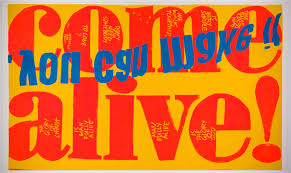
Corita Kent, also known as Sister Mary Corita, was a religious sister, educator, and artist with a unique approach to design and education. Corita’s work depicted her thoughts on poverty, racism, and war. She is mostly known for working mostly with silkscreen (serigraphy). At the sametime, her work was noticible because of how she pushed back the limitations of the two-dimensional medium by the development of innovative methods. Until now, her ideas on peace and social justice are still highly acclimed.
Stephen Powers was born and raised in Philadelphia, PA. He was known as ESPO because at the age of 16 (in 1984), he would write the name” ESPO” around his neighborhood. He was also part of the group of taggers that were asked by the Philadelphia Anti-Graffiti Network (PAGN) to sign a pledge promising not to vandalize property. He refused to sign it and eventually took “ESPO” around the world. Later, Powers decided to stop writing graffiti to pursue being a full-time artist and moved to New York City. He was part of the 50+ mural project called Love Letters in Philadelphia, PA. He’s known for his typography use and colorful style.
Round Composition: Top side of one of Weingart’s round compositons
Wolfgang Weingart, born in 1941, in the Salem Valley, Germany, is known to be a typographer, graphic designer, and theacher. In 1947, after Weingart started school, he noticed the academics weren’t a part of his stregnths. It was at this time that Weingart took a great interest in making things with his hands. After exploring his potential with his hands, he learned “that intellect can be expressed and cultivated through handwork”. He later moved to Lisbon in 1954, at the age of 13 and began his constant exposure to art and taking serious artistic classes. At the age of 17, after experiencing many mediums, Weingart still wasn’t sure about what he wanted to do for a career but felt that, overall, he was going in the right direction. At this time, he was at the Merz Academy in Stuttgart, Germany. His experience there led him to his enrollment at the Basel School of Design where he had gone to study typography. In later years, he experimented more with typography and began creating now-well-known projects such as “Round Compositions.” These were actually done because of and accident. He had dropped a drawer full of heavy type and when they scattered across the floor, instead of repacking them, he put them into a round cardboard ring. He did this in a random order and facing upwards. This gave him two printable sides, the top and the bottom. The bottom wasn’t actually intended to print, but, it gave him the opportunity to experiment even more. 1941, in the Salem Valley, GermanyWolfgang Weingart, born in is known to be a typographer, graphic designer, and theacher. In 1947, after Weingart started school, he noticed the academics weren’t a part of his stregnths. It was at this time that Weingart took a great interest in making things with his hands. After exploring his potential with his hands, he learned “that intellect can be expressed and cultivated through handwork”. He later moved to Lisbon in 1954, at the age of 13 and began his constant exposure to art and taking serious artistic classes. At the age of 17, after experiencing many mediums, Weingart still wasn’t sure about what he wanted to do for a career but felt that, overall, he was going in the right direction. At this time, he was at the Merz Academy in Stuttgart, Germany. His experience there led him to his enrollment at the Basel School of Design where he had gone to study typography. In later years, he experimented more with typography and began creating now-well-known projects such as “Round Compositions.” These were actually done because of and accident. He had dropped a drawer full of heavy type and when they scattered across the floor, instead of repacking them, he put them into a round cardboard ring. He did this in a random order and facing upwards. This gave him two printable sides, the top and the bottom. The bottom wasn’t actually intended to print, but, it gave him the opportunity to experiment even more.




 Foundations of Art, Design, + Digital Culture