Shock Art

The Physical Impossibility of Death in the Mind of Someone Living by Damien Hirst (c.1991)

Shock art is a term that describes a style of art that meant to shock viewers through disturbing imagery, sounds, or scents. Considering our last project has a lot to do with interaction, I thought that this would be an interesting topic to blog about, especially given that shock art is so reliant on viewer involvement. 

Some famous shock artists include Damien Hirst, Andres Serrano, and Piero Manzoni. All of these artists have infamous pieces that show the extremes of shock art. For example, Hirst created The Physical Impossibility of Death in the Mind of Someone Living, a dead shark suspended in a tank of formaldehyde. Serrano created a piece called Piss Christ, a photo of a crucifix placed in the artist’s urine. Finally, Manzoni made a piece called Artist’s Shit in which he filled 90 tin cans of his feces. The piece was ultimately sold at Sotheby’s for 124,000 euros. 

All three of these artists used shock as a way to spark conversation. Although many critics denounce this type of art as a cheap ploy, the style itself does raise the question of what should be constituted as art and why. 

For more information on shock art and examples of pieces, click here.
hitchBOT

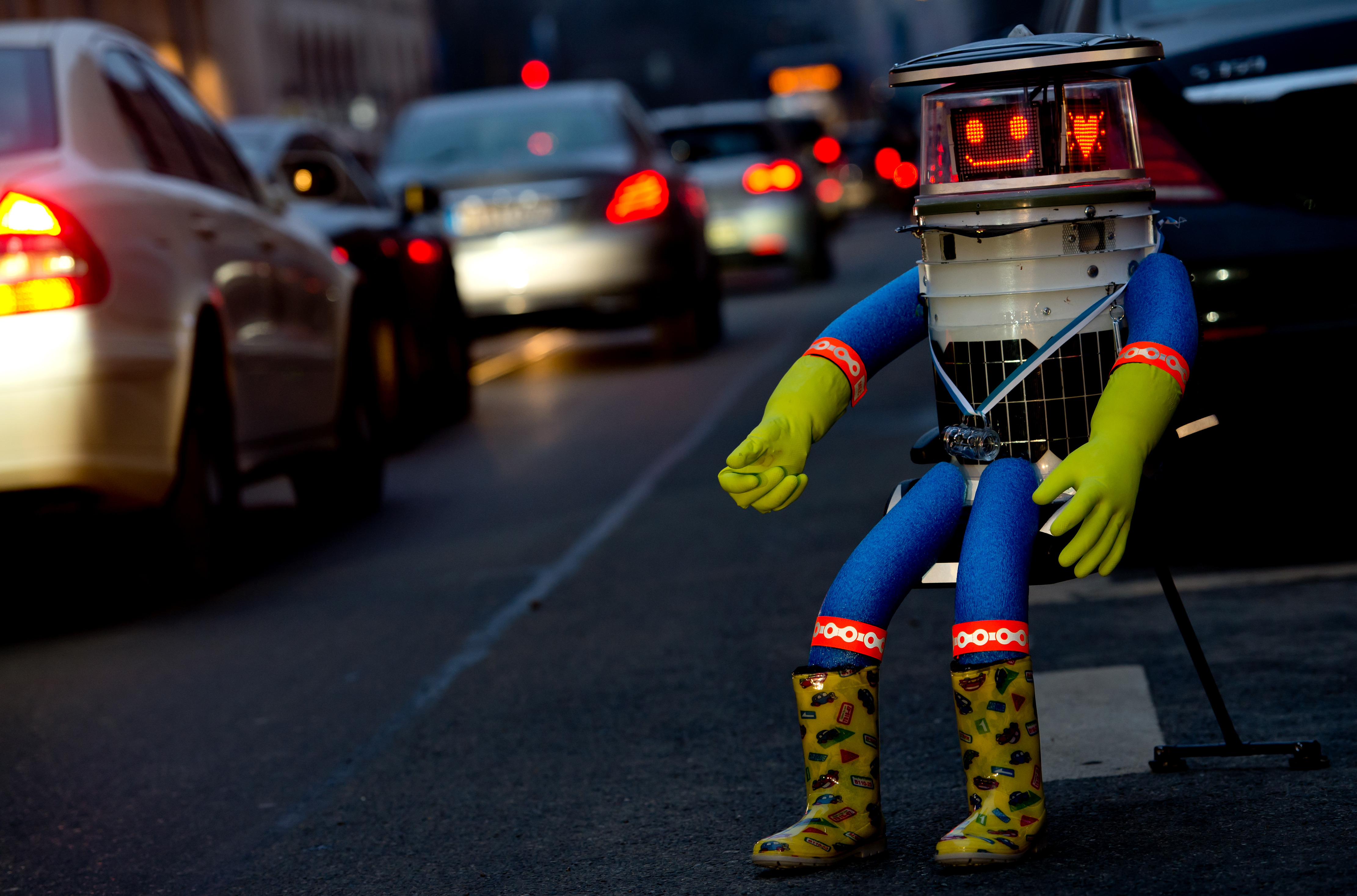
A picture of hitchBOT

hitchBOT was a hitchhiking robot created by two Canadian professors. Although it is physically unable to move itself, it can hold conversations and contains a GPS. It was designed to travel from one point to another through hitchhiking. The robot would ask drivers for a ride and journey across whatever country it was in. Overall, it’s traveled through Germany, Canada, and the Netherlands. However, it’s time ended in the United States, where it was decapitated here in Philadelphia.

The robot itself raised a lot of interesting questions about trust between robots and humans. Are robots able to trust humans? Furthermore, it provided a new perspective on how we interact with technology, especially since this robot relies on more human qualities than on computation.

For more information on hitchBOT, click here.

Dismaland

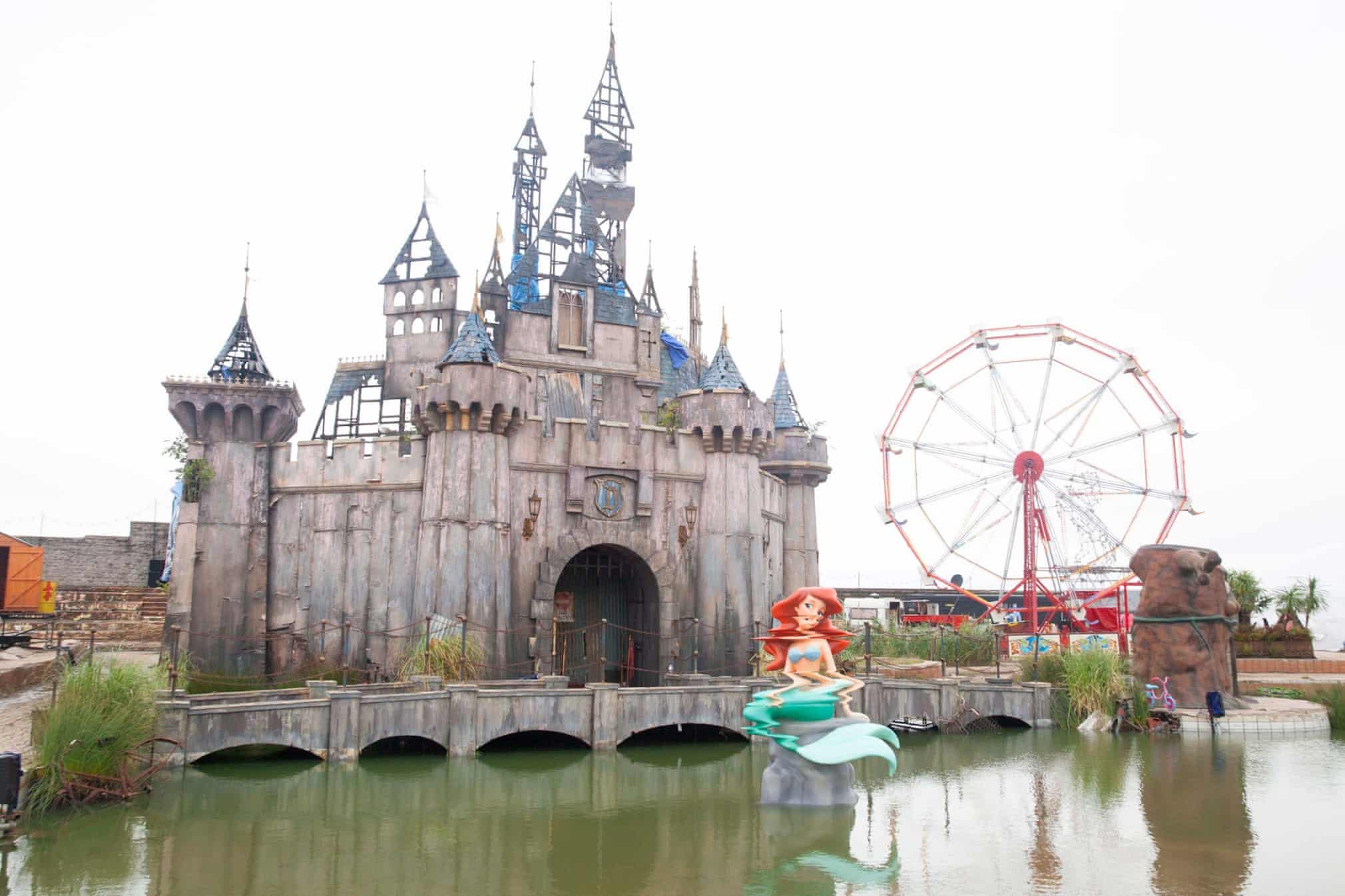
The Dismaland castle and a reimagined Little Mermaid sculpture by Banksy

Dismaland was a temporary art show organized by anonymous street artist Banksy. During its construction, the locals were told that it was a movie film site. However, it was later revealed to be an exhibition that took a dark spin on Disneyland.

The exhibition itself featured works by 58 artists–some of which included Jenny Holzer, Damien Hirst, Mike Ross, and Banksy himself. Musicians also had scheduled performances throughout the day. Many of the pieces in the exhibition blended social issues such as immigration and surveillance with traditional theme park ploys. For example, Banksy’s Immigrants on a Boat addressed the dehumanization and mistreatment of immigrants. Like in many theme parks, participants could control several motorized boats in a pond of water. However, some boats were packed with migrant workers while one of the boats was a gun boat.

I found this exhibition to particularly interesting due to its engagement of the public; the mystery surrounding its construction, the play on Disneyland, and the social commentary that the exhibition engaged in all made a large social impression and sparked conversation.

To learn more about this project, you can click here for information or here for pictures.

Jenny Holzer

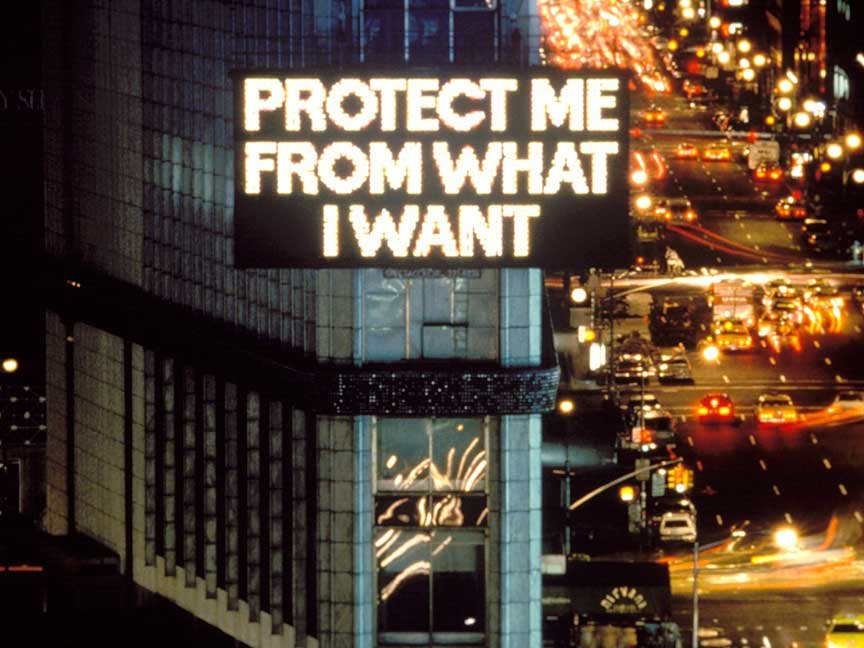
Billboard from Survival series by Jenny Holzer (c.1985)

Since a lot of our intervention pieces involve text, I thought it would be interesting to blog a bit about Jenny Holzer. Jenny Holzer is a neo-conceptual artist that creates a lot of text-based work. She often displays a series of one-liners on anything from t-shirts to light projections and LED signs. Most of these one-liners are very insightful and personal. 

She plays with the contrast between her message and the medium in a lot of her pieces. For example, the personal nature of the one-liners (such as those in her series Truisms) juxtapose the communicative nature of the LED signs. LED signs are used to convey informative things such as the time, date, and directions. Thus, it’s a juxtaposition to put a personal statement on an inherently non-personal medium.  

A lot of her art is also public and achieves some kind of social intervention. She was one of the first artists to utilize information technology as a means for political protest. In fact, she even has a piece of art outside of Hill (125 Years) which celebrates women enrollment at Penn.

For more information on Jenny Holzer, click here.

Tilted Arc

Tilted Arc by Richard Serra (c.1981)

The Tilted Arc was a Minimalist steel sculpture created by Richard Serra. Its creation was commissioned specifically for the Federal Plaza in 1981. I thought that this sculpture would be an interesting piece to talk about given its reception and impact on how people interacted with their environment (which is similar to what we are doing in Project 4). 

The piece was very controversial due to the negative public response. Since it was very large and bisected the Federal Plaza, it was seen as imposing and disruptive to many workers’ daily routines. Many people called for the piece to be removed or relocated. However, the relocation of the piece would destroy the artwork as a whole. Tilted Arc was specifically made for the Federal Plaza; any other location would ruin its meaning. In this case, Tilted Arc was meant to redirect the flow of traffic within Federal Plaza and cause normally-hurried people to slow down. Relocating Tilted Arc to any other place would render the entire piece as useless.

After a trial of the piece, Tilted Arc was ultimately removed, deconstructed, and stored. For more information on this piece and its controversy, click here, here, or here.

Black Death Spectacle Intervention

A picture of Bright during the intervention

As our last project wraps up, I wanted to look into other famous interventions in the art world. One small but powerful one that I came across was a protest staged by Parker Bright. The protest is in reaction to a piece created by Dana Schutz. The painting depicts an abstracted shot of Emmett Till’s face and torso in an open casket. This piece was displayed at the Whitney Biennial, but sparked controversy due to the fact that the artist who painted it was white and had abstracted an otherwise serious subject matter. 

In response to this piece, Bright and a group of five to six people stood in front of the painting for the entirety of the Whitney’s opening hours, completely blocking the piece from view. They also wore shirts with the with the words “black death spectacle” written across them to convey their opinion of the damaging nature of the painting.

For more information on the protest, click here.

Iris van Herpen

Piece from van Herpen’s Hypnosis collection (July 2019)

I recently saw Iris van Herpen’s work online, and it reminded me of some of the concepts we explored in Project 3. Van Herpen is a Dutch fashion designer that focuses on invention, sculpture, and movement in her pieces. She has pushed the boundaries in fashion and art by combining traditional Couture techniques with unconventional materials such as 3D printing. This unique combination lends itself to many sculptural, visually-interesting pieces inspired by a variety of topics–some of which include architecture and science. Van Herpen is also well-known for her use of movement in her pieces. She takes a traditionally rigid medium (3D printed plastics) and transforms it into a lively material. 

Both of these concepts–sculpture and movement–are further explored through van Herpen’s collaborations. Instead of sticking to a single discipline, van Herpen works with a variety of different people in order to develop inventive collections that explore the relationships between fashion, art, and any other field imaginable.

For more information on van Herpen, watch this video.

Cinemagraphs

Untitled cinemagraph by Kevin Burg and Jamie Beck

Pioneered by Kevin Burg and Jamie Beck in 2011, cinemagraphs are gifs that feature an isolated movement in an otherwise-still photograph. They are able to capture and emphasize minute movements, such as the movement of water or the shifting of light. This subtle movement forces the viewer to slow down and address the peaceful, uncannily-calm nature of the cinemagraph. On top of their intriguing optics, cinemagraphs also mark an intersection between the digital age and fine art. Previously, gifs have been regarded as silly or unprofessional; cinemagraphs, however, demonstrate how gifs can take form in what is defined as “fine art” as well. 

For more examples of cinemagraphs, click here.

Nathalie du Pasquier

Nathalie du Pasquier, 2019

Nathalie du Pasquier’s work has the capacity to heavily influence how we approach design in this class, especially as we move into more abstract design. She is both an artist and a designer. Her early years began as a designer of the Memphis Group, an iconic design and architecture collective that was inspired by Art Deco and Pop Art. During this time, she created a plethora of lively furniture and prints that were inspired by her travels across the world. This style of design eventually became one of the most recognizable features of the Memphis Group as a whole.

Following the disbanding of the Memphis Group, du Pasquier continued to work as a sculptor and painter. She experimented with the translation of forms through medium as well as the assemblage of the mundane into interesting forms. Through du Pasquier’s work, cups could be converted into columns or turned upside down. The mundane is transformed through the experimentation with how it can be assembled. 

This focus on how objects are assembled has continued into her contemporary work, in which she paints still lifes of various arrangements of found objects. These more recent paintings focus on element, form, and arrangement–blending the boundaries between fine art and design.

For more information on Nathalie du Pasquier and her work, click here.

Lee Bontecou’s Drawings

Lee Bontecou, ‘Untitled’ (c.1963)

Lee Bontecou is a prominent sculpture artist, but a lot of her drawings actually remind me of several of the Project 1.1 designs that were shown in class. Most of Bontecou’s drawings are used as a place to ideate her sculptures. Consequently, she often goes back and forth between her drawings and the development of her sculptures, developing abstract and often otherworldly drawings. This continuous toggling between drawing and sculpting parallels the sort of exploration that we did in Project 1.1 (and something we will continue to do in Project 1.2). Bontecou’s method is one that is largely based off of discovery; she recognizes this process of thinking out her pieces through drawings as an art form within itself.

On top of the process, Bontecou’s drawings incorporate a wide range of materials. She draws with materials such as soot, graphite, and knives on surfaces ranging from the likes of muslin to plastic. This variety of materials provides distinctly unique characters to each of Bontecou’s drawings.

For more information on Bontecou and her drawings, click here.