Philip Treacy is an award-winning London based haute couture milliner (hat designer). Treacy has been associated with some of the largest fashion houses and particularly Chanel and Givenchy, as well as celebrities such as Isabella Blow, Lady Gaga, Madonna and Sarah Jessica Parker. He has been associated with British royalty, and has designed hats for royal occasions.
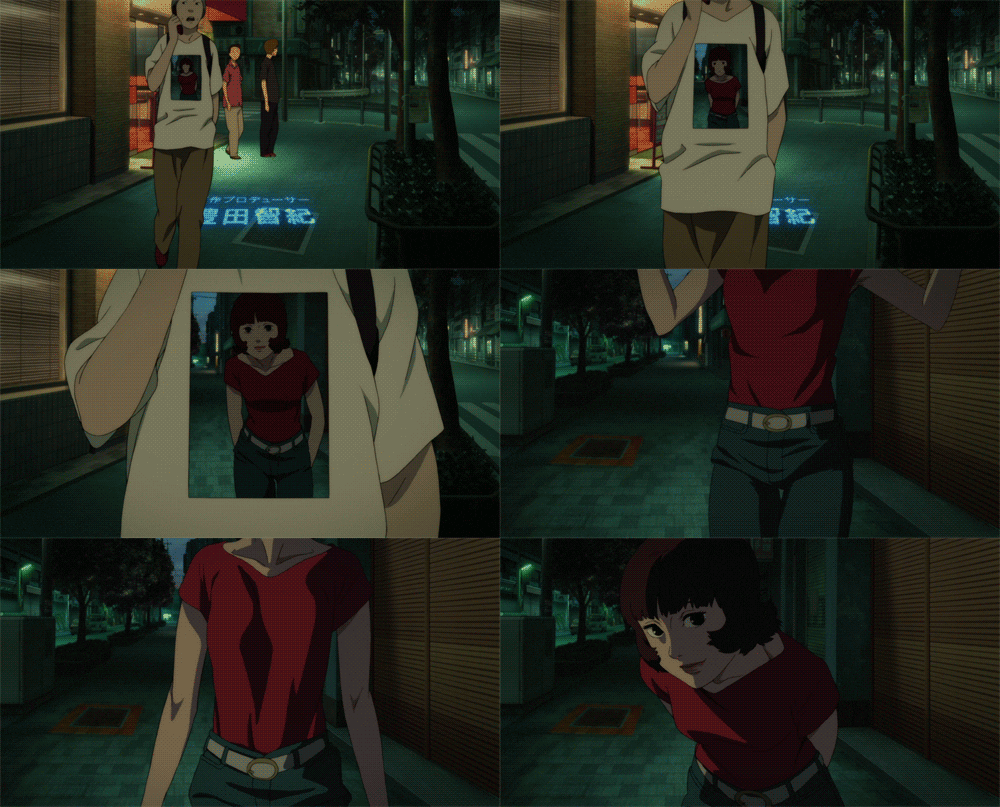
Satoshi Kon is a director of animated films. Some titles he has directed are Perfect Blue, Paranoia Agent, and Paprika. One thing he is knows for is his use of transitions as seen here:
This is a museum/art installation in Japan, done mostly through digital projections. People travelling through the exhibit/space influence how the projections change. While you move through the rooms, a companion app on your phone tells you a bit about the projections in the room and how they interact with the other projections and with the people in the room.
For example, in the picture below, the waterfall makes the flowers grow, while people’s shadows passing over the flowers will make them wither/fall away. In addition, flowers will grow around people standing in place.
Also, the various projections generated in different rooms interact with each other. In one room, when you stand still, butterflies are generated. These butterflies will scatter into all of the rest of the exhibit. They are only generated from that room, and when people come into contact with them, they disappear.
There’s (probably) a lot of code behind this that keeps track of what should be projected and what no longer should be projected. The coolest part about the exhibit is that because of all the interactions, it’s constantly changing and will never look the same.
Here’s a link to their site, where they have a video of the various exhibits on the home page:
4-koma is a style of comic originating in Japan. It’s called such because the layout consists of 4 equal sized panels. Originally, they were used for gag/comedy comic strips, although now there are more slice-of-life genre comics being done in this style.
As stolen from Wikipedia:
Traditionally, yonkoma follow a structure known as kishōtenketsu. This word is a compound formed from the following Japanese kanji characters:
Ki (起): The first panel forms the basis of the story; it sets the scene.
Shō (承): The second panel develops upon the foundation of the story laid down in the first panel.
Ten (転): The third panel is the climax, in which an unforeseen development occurs.
Ketsu (結): The fourth panel is the conclusion, in which the effects of the third panel are seen.
Azumanga Daioh by Kihohiko Azuma
The layout of our instruction guide project is also a 4-koma!
This stainless steel sculpture created by Zhang Huan is a commissioned piece that stands outside the Shangri-La Hotel in Toronto.
The pictures aren’t mine but I got the chance to see this piece over the weekend. From afar, I thought the piece looked like some monstrous plant beast, shedding leaves as it walked. I didn’t realize they were doves until I got a lot closer.
What I love most about this piece is the sense of movement in both the creature and the doves. I also noticed the contrast between the fluidity of the giant creature, and the harsh lines and placement of the doves. The doves are clustered more towards the front, almost as if to hide the face of the creature, but the way they are flying away suggests that the creature is being slowly unveiled.
In addition to Rising, Zhang Huan has a bunch of other works including paintings, photography, and performance art, of which he is more well known for.






 Foundations of Art, Design, + Digital Culture