


instagram link:


In this project you will work with poetry—interpreting, mashing up, composing a text—then translating to create animated narratives using found or generated photographic and graphic images. You’ll first develop texts and a static image (storyboard) as a design plan, then produce an animated interpretation (not an illustration) that expresses the spirit and meaning of the text.
Like contemporary postmodern digital culture, Dada poetry and photomontage are relevant starting points for this project as they originate in media and, when mashed-up, can be simultaneously nonsensical, random and curiously poignant. Dada was an art movement formed during the First World War as a reaction to the horrors and folly of the war. The art, poetry and performances produced by Dada artists are often satirical and nonsensical in nature, making the absurd into a critique of modern culture.
Photomontage, the making of composite photographs by cutting, gluing, rearranging and overlapping photographs into a new image, was one of the techniques used by Dada artists to criticize corrupt culture.
For Project 2 you can use any text as a source to interpret or compose. See these sources: the Poetry Foundation, and Poets.org.
The project has 2 parts: a static image/storyboard and a 25-30 second movie file with sound (for screening Tuesday October 29).
* Readings/Video/Sites, for October 15: (discussion leaders: )
* Video, Animated Gifs – the Birth of a New Medium
* Reading from McCloud’s Understanding Comics, The Six Steps
* Postmodernism, definition (read Hebdige’s quote, p 154-155)
* Dada Was Born 100 Years Ago, So What?, NYTimes
* How to Make a Dadaist Poem, Tristan Tzara, 1920
For browsing:
Julian Rosefeldt Manifesto video installation – # 6 is the Dada manifesto
Gifs Worth at Least a Thousand Words, NYTimes


Selected student animations, fall 2015 , fall 2016, and summer 2016
First Gif sketches, and more
“Meet and Mingle” – Dorothy Espalto


Animation exercise spring 2018
Animation exercise summer 2018
Animation exercise 2017
Animation exercise 2016
Summer 2016
GIF animations 2015

Jason Anderson is a UK based artist that has recently begun creating colorful landscapes using pixelated patches of pastel-toned oil paint. I chose these pieces because many of them in some way represent a city or a town, but the images are also very abstract like the one pictured below.

Each of his pieces are created on linen and centered around a focal point, normally one that is bright yellow to represent the sun or a train or a car. His career interestingly started doing stain glass restoration and claims that this style still influences his work as a painter.


In addition to painting abstract, Anderson also paints realistic portraits and nature scenes.


Isak – this is the artist I was thinking of!

.jpg)


British artist Tony Cragg regularly uses materials like plastic, fiberglass, bronze, and Kevlar to create fluid 3D sculptures and art installations. As someone who normally does graphics and more cartoon-ish art, Cragg’s fluidity is what I’m trying to work towards.
Stuart Davis is an American painter that was well known in the 1940s and 1950s for his colorful and bold style. Davis often aimed to convey a political messages about marxism, class struggles, and the Great Depression through his paintings. Personally, I really love the way he can make odd shapes, striking colors, and text come together in a cohesive yet chaotic way.


As per the theme of our next project, I started exploring works that circled around cities. I looked at paintings, and they varied drastically. All art varies drastically, but I just found it interesting how different the emotions being evoked by each painting were. Here are a few in particular that I found to be beautiful and great examples of this point.


Nathalie du Pasquier’s work has the capacity to heavily influence how we approach design in this class, especially as we move into more abstract design. She is both an artist and a designer. Her early years began as a designer of the Memphis Group, an iconic design and architecture collective that was inspired by Art Deco and Pop Art. During this time, she created a plethora of lively furniture and prints that were inspired by her travels across the world. This style of design eventually became one of the most recognizable features of the Memphis Group as a whole.
Following the disbanding of the Memphis Group, du Pasquier continued to work as a sculptor and painter. She experimented with the translation of forms through medium as well as the assemblage of the mundane into interesting forms. Through du Pasquier’s work, cups could be converted into columns or turned upside down. The mundane is transformed through the experimentation with how it can be assembled.
This focus on how objects are assembled has continued into her contemporary work, in which she paints still lifes of various arrangements of found objects. These more recent paintings focus on element, form, and arrangement–blending the boundaries between fine art and design.
For more information on Nathalie du Pasquier and her work, click here.
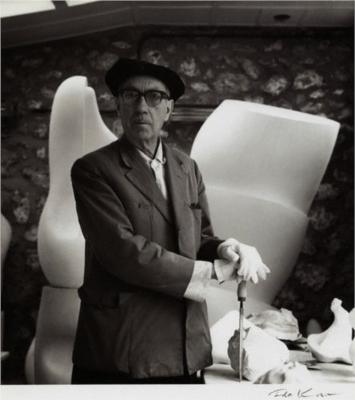
Jean Arp was a German-French artist of many forms. He was a painter, sculptor, poet, and multimedia abstractist. His work first appeared in a gallery in 1925 while he was working with a group of a few other artists who called themselves the Cologne Dada group. Professor Comberg mentioned Jean Arp to me when looking over one of my designs from project 1.1. It wasn’t what I chose as my final, but you get a glimpse of it from my studies board. It was an abstract reflective piece that I do agree, resembles the fluid shapes of Arp’s creations.

Arp’s poetry came before his sculptures and paintings. He published his words for the first time in 1904 while he was in Paris. Arp had an interesting life journey through volatile Europe. He was born in Germany and studied there from 1905-1907. He claimed to be mentally ill in order to avoid being drafted into the german military and ended up moving to Switzerland in 1915 because he favored the nation’s neutrality. He spent various amounts of time in various cities across France, Germany, and Switzerland and maybe it was this mobile existence that influenced the shapes with which he decided to express himself through his art.


 Foundations of Art, Design, + Digital Culture