The Course Folder is available to store project submissions – Use the Public Folder and the sub-folder Project 1.1. Post only PDFs Smallest File Size.
To access the Course Folders, from pull-down menu: Finder > Go > Connect to Server
or from keyboard CMD+K
Use server address: smb://juno.design.upenn.edu/courses
Submit PDFs of Project 1.1 studies Use the naming protocol: Last name.project1.1.studies.pdf
and submit PDFs of final Use the naming protocol: Last name.project1.1.final.pdf
Kwon Young-woo (1926-2013) was an artist who specialized in dansaekhwa, a Korean genre of monochrome painting. Young-woo’s uniqueness came from experimenting with Korean rice paper, hanji, and Chinese ink, meok, which he would cut, rip, tear, and layer in order to add texture. While we are mostly working with digital artwork, I think this is an important example of how small things such as tweaking texture can affect the mood and aesthetic of a piece.
Kandinsky was a Russian painter and artist that is oftentimes viewed as the catalyst for abstract art. He was inspired by color symbolism, psychology, and sound. His older paintings were more impressionistic, while his return to Russia and Germany in the 1920s began the era of his most iconic work which was radically expressionistic — which you can see in the photos of some of his work I have attached. He started with biomorphic shapes and leaned into non-geometric lines to reflect sounds around his world.
His style is very on-par with the activities/studies we’ve done so far in class, with the exception that his works were all done by-hand through paint while we’ve worked mostly digitally.
Here are instructions for printing on the laser printers and the large format plotters. You will be printing on these often this semester for your projects.
This stainless steel sculpture created by Zhang Huan is a commissioned piece that stands outside the Shangri-La Hotel in Toronto.
The pictures aren’t mine but I got the chance to see this piece over the weekend. From afar, I thought the piece looked like some monstrous plant beast, shedding leaves as it walked. I didn’t realize they were doves until I got a lot closer.
What I love most about this piece is the sense of movement in both the creature and the doves. I also noticed the contrast between the fluidity of the giant creature, and the harsh lines and placement of the doves. The doves are clustered more towards the front, almost as if to hide the face of the creature, but the way they are flying away suggests that the creature is being slowly unveiled.
In addition to Rising, Zhang Huan has a bunch of other works including paintings, photography, and performance art, of which he is more well known for.
Gérard Paris-Clavel | born in 1943 in Paris | studied at the Ecole des Métiers d’Arts
This image reminded me of the intro to Psycho we watched in class. Although the lines are not moving across the picture like in the film, the varying lengths and distinct orientations create a sense of movement in the still picture. The emerging person gives the impression of something being set into motion. This makes sense as Clavel’s work was linked to political movements.
“It is important to have elements that permit us to share our experiences with others. For us, images are only tools. We don’t have the cult of the result. It is the activity they help to produce that we are after.” – Clavel
It’s interesting that simple images can communicate messages to people and even inspire actions.
I looked at this artist in class because one of the things I created for project 1 was very similar to this style except in black and white. I think it is very aesthetically pleasing and the lines and colors are effective in moving the viewers eyes all around the piece. It is probably something most people have seen before and yet don’t actually know the artist.
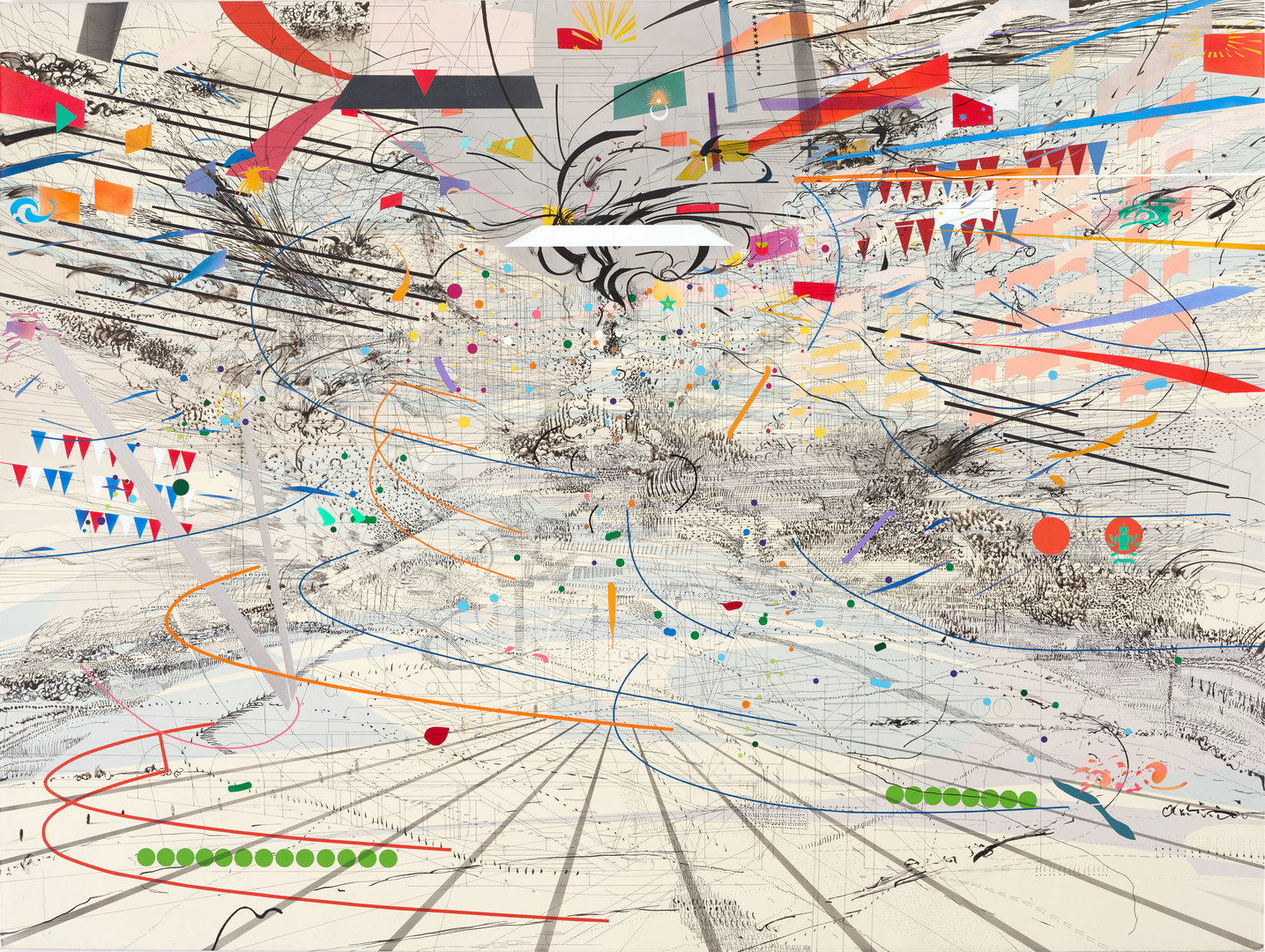
Julie Mehretu’s art was intriguing to me because we briefly learned about her last semester in FNAR123, additionally, her art reminds me of the pieces I see in DRL. I find the collaboration between math and art to be very satisfying and aesthetically pleasing, because they often look as though they were generated by machines as the byproduct of calculations. They look like pieces put together from the scraps and remains of analogue computers’ punch cards.
Julie Mehretu’s “Congress” DRL artwork
I noticed that in both pieces above, there are elements brought to the front and more muted shapes that resemble guidelines in the back. Defined shapes such as circles, triangles, and lines make up the majority of both pieces, though Mehretu’s piece contains more varied textures/strokes.
Mehretu was born to an Ethiopian and American household. Her family left Ethiopia in 1977 to escape political turmoil, and as such, many of Mehretu’s pieces express global changes in society and politics over a long period of time.
The characters in my maps plotted, journeyed, evolved, and built civilizations. I charted, analyzed, and mapped their experience and development: their cities, their suburbs, their conflicts, and their wars. […] As I continued to work I needed a context for the marks, the characters. By combining many types of architectural plans and drawings I tried to create a metaphoric, tectonic view of structural history.
Bridget Riley – FallOne of my drawing for project 1
The reason why I found Bridget Riley interesting is that her work reminds me of drawings I did for project 1 in our class. After doing some research about her, I learned some intriguing facts about her.
Finalized versions of Bridget Riley’s paintings are not done on her own but by her assistants. She only draws the first composition and leaves the precision work to her assistants.
The value of her paintings from 1985 to 2019 has increased by 25,500 %. The price of one of her paintings, Chant 2 (1967), is $5.1 million today. Who would think that so ‘simple’ sketches could be sold for that much money… This is why she makes the list of top 10 most expensive living women artists.
While doing my project, my eyes felt weird from staring at hundreds of lines and shapes, because of the dynamic effect it produced. It is said that looking at one of Riley’s drawings (Late Morning I (1967)) can result in motion sickness or even hallucination.
To end my blog post about Riley Bridget, I would like to share one of her famous quotes: “I work with nature, although in completely new terms.” It proves that behind each of her drawings there is an element from nature, for example a straight or curved line, which is manipulated so that it yields a work of art.




 Foundations of Art, Design, + Digital Culture