Interventions at MoMA

In 2015, MoMA opened an exhibit about public interventions at MoMA over the past 75 years. While it is admirable that such a reputable institution is open to being challenged by artists and the public, the exhibit was entitled, “Messing with MoMA,” which I believe downplays some of the significance of the interventions being put on display. For example, several interventions dealt with sexism in art. I struggle with calling these interventions just the public “messing” with MoMA. With that said, MoMA is giving a sort of credit to these interventions for bringing the institution to where it is today. As a whole, I think the exhibit was a really neat and creative idea.

More information about the interventions that were part of the exhibit can be found here: https://post.at.moma.org/content_items/804-messing-with-moma-critical-interventions-at-the-museum-of-modern-art-1939-now?_ga=2.97520863.1702438378.1576727747-686069336.1576727747

Shock Art

The Physical Impossibility of Death in the Mind of Someone Living by Damien Hirst (c.1991)

Shock art is a term that describes a style of art that meant to shock viewers through disturbing imagery, sounds, or scents. Considering our last project has a lot to do with interaction, I thought that this would be an interesting topic to blog about, especially given that shock art is so reliant on viewer involvement. 

Some famous shock artists include Damien Hirst, Andres Serrano, and Piero Manzoni. All of these artists have infamous pieces that show the extremes of shock art. For example, Hirst created The Physical Impossibility of Death in the Mind of Someone Living, a dead shark suspended in a tank of formaldehyde. Serrano created a piece called Piss Christ, a photo of a crucifix placed in the artist’s urine. Finally, Manzoni made a piece called Artist’s Shit in which he filled 90 tin cans of his feces. The piece was ultimately sold at Sotheby’s for 124,000 euros. 

All three of these artists used shock as a way to spark conversation. Although many critics denounce this type of art as a cheap ploy, the style itself does raise the question of what should be constituted as art and why. 

For more information on shock art and examples of pieces, click here.

hitchBOT

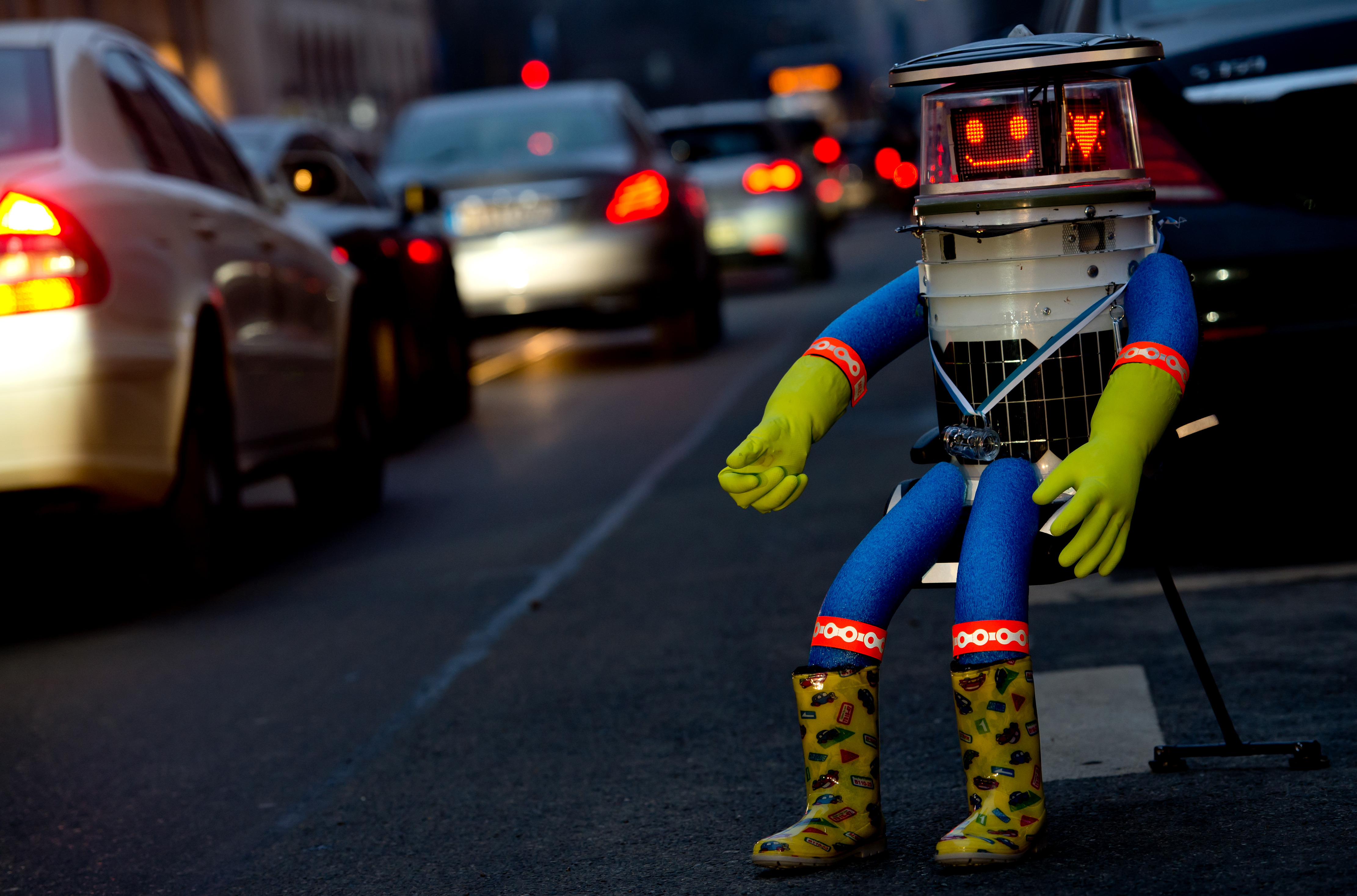
A picture of hitchBOT

hitchBOT was a hitchhiking robot created by two Canadian professors. Although it is physically unable to move itself, it can hold conversations and contains a GPS. It was designed to travel from one point to another through hitchhiking. The robot would ask drivers for a ride and journey across whatever country it was in. Overall, it’s traveled through Germany, Canada, and the Netherlands. However, it’s time ended in the United States, where it was decapitated here in Philadelphia.

The robot itself raised a lot of interesting questions about trust between robots and humans. Are robots able to trust humans? Furthermore, it provided a new perspective on how we interact with technology, especially since this robot relies on more human qualities than on computation.

For more information on hitchBOT, click here.

Octavi Serra, artist

Serra is a Spanish artist whose aim is to capture the ironies and frustrations of modern life. Through his conceptual art installations, he pokes fun at pop culture and calls attention to the most pressing issues of our world today. Though his work is often simple, it is effective in its ability to challenge the status quo we often don’t realize we live by.

For more about the artist, here is his website: https://ooss.eu/.

Dan Flavin

I first saw Dan Flavin’s work at the Dia:Beacon museum last semester. However, recently I have seen more and more products for commercial colored lighting that remind me of his work.

This is my favorite piece by him. It is the one I most vividly remember interacting with at Dia:Beacon. When you look at it perpendicularly (like this picture shows), at its most extreme angle, the blue light is masked by the other panels and you can only see red. Similarly, when you move from the right side to look at it all the way on the left side the red is masked and you only see blue light. At the time I was taking a biology course and it reminded me of a heart and how blue blood becomes oxygenated with each pump to become red.

You may recognize this piece by him that is currently located at the MoMA.

He also uses light in functional ways as seen here. Overall I love his minimalistic style and I think his use of fluorescent light will become more popular in response to new decor trends. Here is a link to more of his work!

Protests & Art

We have discussed the influence of design and organization within demonstrative art or political protest. There can be great influence, as we have discussed in our readings and discussion. Currently in Hong Kong there are student protests going on across the city. Artists and designers have been working quickly and weaving demonstrative art to aid in their protests and punctuate the claims of their cause.

Portraits designed to be stepped on as pedestrians cross a busy bridge in Hong Kong
Posters on a wall in northeastern Hong Kong likening front line protestors to action film protagonists

Dismaland

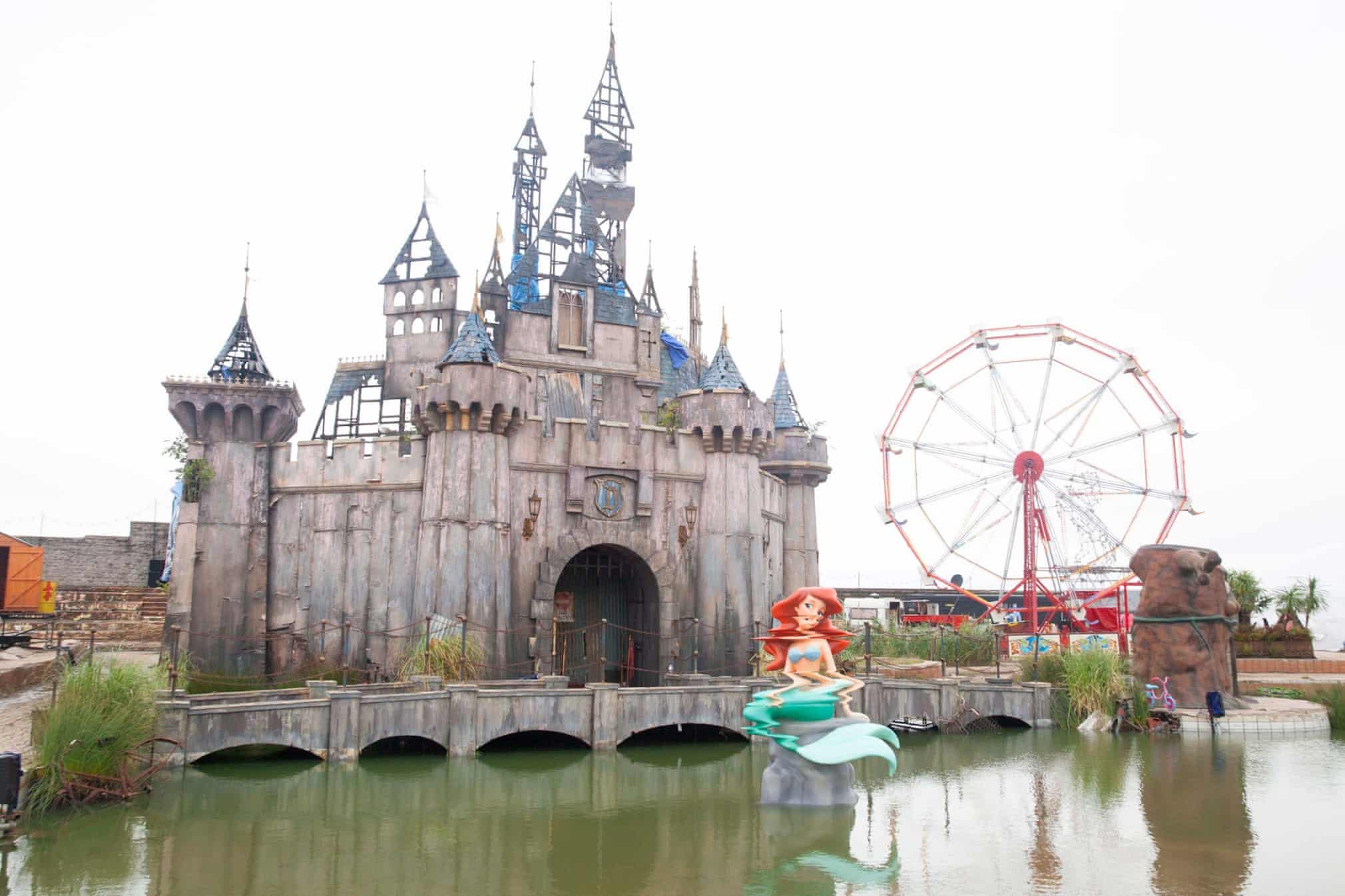
The Dismaland castle and a reimagined Little Mermaid sculpture by Banksy

Dismaland was a temporary art show organized by anonymous street artist Banksy. During its construction, the locals were told that it was a movie film site. However, it was later revealed to be an exhibition that took a dark spin on Disneyland.

The exhibition itself featured works by 58 artists–some of which included Jenny Holzer, Damien Hirst, Mike Ross, and Banksy himself. Musicians also had scheduled performances throughout the day. Many of the pieces in the exhibition blended social issues such as immigration and surveillance with traditional theme park ploys. For example, Banksy’s Immigrants on a Boat addressed the dehumanization and mistreatment of immigrants. Like in many theme parks, participants could control several motorized boats in a pond of water. However, some boats were packed with migrant workers while one of the boats was a gun boat.

I found this exhibition to particularly interesting due to its engagement of the public; the mystery surrounding its construction, the play on Disneyland, and the social commentary that the exhibition engaged in all made a large social impression and sparked conversation.

To learn more about this project, you can click here for information or here for pictures.

Jenny Holzer

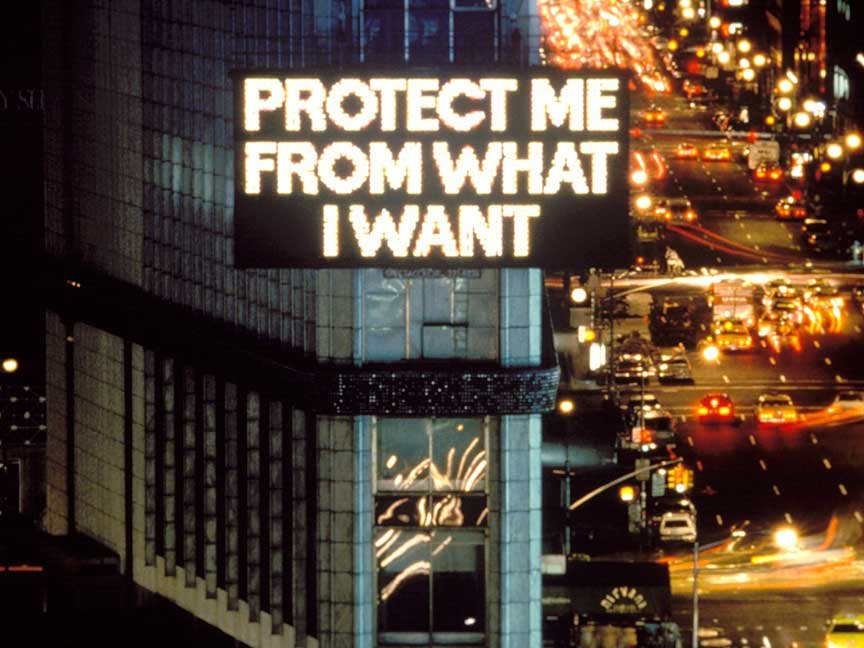
Billboard from Survival series by Jenny Holzer (c.1985)

Since a lot of our intervention pieces involve text, I thought it would be interesting to blog a bit about Jenny Holzer. Jenny Holzer is a neo-conceptual artist that creates a lot of text-based work. She often displays a series of one-liners on anything from t-shirts to light projections and LED signs. Most of these one-liners are very insightful and personal. 

She plays with the contrast between her message and the medium in a lot of her pieces. For example, the personal nature of the one-liners (such as those in her series Truisms) juxtapose the communicative nature of the LED signs. LED signs are used to convey informative things such as the time, date, and directions. Thus, it’s a juxtaposition to put a personal statement on an inherently non-personal medium.  

A lot of her art is also public and achieves some kind of social intervention. She was one of the first artists to utilize information technology as a means for political protest. In fact, she even has a piece of art outside of Hill (125 Years) which celebrates women enrollment at Penn.

For more information on Jenny Holzer, click here.

Rupert Van Wyk

Rupert Van Wyk is an artist I found while scrolling through Pinterest this summer.

I have always liked cartoon-like drawings, but his work especially catches my eye.

I really like the way he uses color to sketch people walking by and it makes his work have a fun, playful feel. This is not the only type of illustration he does either, but you can check out more of his work like this here!

Parallel Studio

Parallel Studio is an animation company that creates gifs and videos for a broad range of clients including Louis Vuitton, Chloé and many others.

This animation is from their satisfying collection which I really enjoyed and I’m sure many others do too.

Here is a link to their website to see more!